Codecs
occamyd sends a desktop as tiles of 64 × 64 pixels, and it picks a
codec for each tile from what the tile shows and whether it's moving.
This page gives the measurements, on frames recorded from a real
desktop, that decided each part of that choice.
How occamyd sends a tile
When the screen changes, occamyd asks four questions of each tile
that changed, to send it in the cheapest form that still shows the
screen as it is:
flowchart LR
  A([A tile<br/>changed]) --> B{Moved by<br/>a scroll?}
  B -- Yes --> C[copy-rect]
  B -- No --> D{In the client's<br/>tile cache?}
  D -- Yes --> E[cached]
  D -- No --> F{Colours}
  F -- Up to 16 --> G[Exact,<br/>deflate]
  F -- 17 to 256 --> H{In motion?}
  F -- Over 256 --> I{In motion?}
  H -- No --> G
  H -- Yes --> J[WebP, lowest<br/>quality, half size]
  I -- Yes --> J
  I -- No --> K[WebP, lowest quality<br/>at SSIM 0.91]
  J -. Still for<br/>300 ms .-> L[Sent again: exact,<br/>or as a still tile]
What occamyd sends gives the rules
as a client sees them, including when a tile is in motion and how
refinement sends it again. These values are occamyd's own:
| What | How occamyd sends it |
|---|---|
| Text that a scroll moved | A copy-rect of what the client already shows, and tiles only for the line that scrolled into view |
| A tile in a slot of the client's cache, 1024 slots by default | A cached tile: the slot's number, and no pixels |
| A lossy tile in motion | Quality 30 of 100, at half its width and height to a client that lists scaled |
| A still lossy tile | The lowest quality, from 30 to 90, at which it reaches an SSIM of 0.91, and never higher than the link allows, which occamyd judges from how fast each client acknowledges its frames |
| Up to 16 lossy tiles side by side in a row | One image, so that the format's headers are paid once |
| Refinement | Only while nothing else waits to be sent, so it never holds up your input by more than one of its messages |
SSIM (structural similarity) scores how alike two images look, where 1 means identical.
What each step saves
Each step was measured by sending this page's frames through
occamyd's encoder with the step and without it:
| What changes on the screen | Without the step | With the step |
|---|---|---|
Text scrolls a line: a copy-rect and a line of tiles |
58.5 KiB and 3.59 ms of encoding a frame | 5.0 KiB and 0.54 ms |
A browser page switched back and forth over the desktop: cached tiles |
79.7 KiB a frame | 9.4 KiB |
A terminal switched back and forth over the desktop: cached tiles |
12.1 KiB a frame | 2.4 KiB |
| Full-screen motion: WebP at quality 30 while it moves | 392.4 KiB a frame, exactly | 13.8 KiB at full size, and 6.9 KiB at half size |
| A photograph shown once: the quality that reaches an SSIM of 0.91 | 150.8 KiB at quality 90 | 121.8 KiB, at quality 87 on most rows |
Refinement then costs a burst once motion stops: 391.0 KiB in 192 messages makes the full-screen motion exact again, and each message took at most 2.6 ms to encode, the longest that a key can wait behind it. At half size, a tile in motion scores an SSIM of 0.986, against 0.988 at full size.
A session's viewers share what occamyd encodes, and two workers a
session encode a frame's rows ahead of them. A photograph shown once
is then ready in 44 ms instead of 96, and four viewers take 163 ms of
CPU for it instead of 374.
Why these codecs
| Choice | Instead of | Why |
|---|---|---|
| A palette with deflate at level 1 | PNG, QOI, lossless WebP | It takes 40 to 48 % of PNG's bytes on the desktop, a terminal's bitmap font and a dragged window, in no more than PNG's encode time. |
| Tiles of 64 pixels | Tiles of 128 pixels | A key costs 0.1 to 1.7 KiB instead of 0.2 to 2.9, and a scrolled line 4.6 KiB instead of 8.7. |
| Pixels in RGBA order | BGRX | Every Go encoder and the browser take RGBA, and x11vnc sends it when asked. |
| WebP for photographs | JPEG | It takes a third to a half of JPEG's bytes at the same quality, for about twice image/jpeg's encode time. |
| WebP for 17 to 256 colours in motion | Exact pixels | It takes a fifteenth of the bytes on full-screen motion, at an SSIM of 0.989. |
| Lossy tiles side by side as one image | One image a tile | A JPEG tile carries about 650 bytes of headers, and a WebP tile 53. |
The sections below give the measurements behind each choice, with each
codec named as The candidates lists it, such as
pal+flate1 or jpeg q70. A cell such as 15.1 · 1.4 holds two
values, in the order of the table's caption.
A palette and deflate for exact tiles
An exact tile goes as its palette and each pixel's index into it,
compressed by deflate at level 1, the fastest. On each scene's tiles of
up to 256 colours, which occamyd sends exactly, at 64 pixels: KiB a
frame · encode ms a frame.
| Codec | desktop | terminal | terminal-aa | browser | drag | scroll | motion |
|---|---|---|---|---|---|---|---|
| pal+flate1 | 15.1 · 1.4 | 17.4 · 1.5 | 103.2 · 3.9 | 125.5 · 4.5 | 12.3 · 1.2 | 55.4 · 3.6 | 388.1 · 8.0 |
| pal+flate6 | 14.4 · 1.9 | 16.4 · 1.8 | 99.5 · 5.0 | 121.6 · 5.9 | 11.8 · 1.6 | 53.6 · 3.7 | 319.4 · 10.8 |
| pal+kflate1 | 15.1 · 1.5 | 17.4 · 1.5 | 103.2 · 3.1 | 125.5 · 3.5 | 12.3 · 1.2 | 55.4 · 3.1 | 388.1 · 6.4 |
| pal+zstd1 | 18.5 · 1.7 | 20.3 · 1.8 | 104.4 · 2.9 | 126.5 · 3.1 | 15.1 · 1.4 | 57.2 · 3.1 | 403.8 · 5.6 |
| png1 | 37.0 · 3.5 | 36.0 · 3.7 | 115.0 · 4.8 | 132.2 · 4.6 | 30.3 · 2.9 | 71.9 · 5.7 | 375.7 · 7.0 |
| png6 | 34.8 · 3.9 | 33.8 · 3.9 | 110.8 · 5.6 | 128.1 · 5.5 | 28.4 · 3.2 | 69.4 · 5.7 | 318.6 · 9.5 |
| qoi | 21.1 · 0.7 | 64.0 · 0.8 | 156.1 · 1.2 | 180.8 · 1.2 | 17.3 · 0.6 | 215.9 · 1.4 | 895.9 · 3.5 |
| webpll-dt4 | 18.8 · 31.5 | 21.5 · 27.2 | 75.0 · 38.4 | 89.7 · 40.2 | 15.4 · 25.7 | 59.2 · 25.3 | 288.0 · 70.1 |
| webpll-vpx4 | 18.6 · 53.4 | 21.1 · 45.2 | 68.2 · 79.8 | 82.0 · 94.7 | 15.2 · 43.7 | 57.4 · 39.7 | 252.9 · 119.4 |
- The palette is smaller than PNG on screen content, from 40 % of PNG's bytes on the desktop and the drag's wallpaper to 95 % on antialiased text, and a tile of one colour costs it 12 bytes where PNG needs 88. It encodes in two fifths of PNG's time on simple tiles and about the same on text. Go decodes it in a quarter to two thirds of PNG's time on tiles of up to 16 colours, and in 70 to 95 % on tiles of 17 to 256, with PNG's palette expanded through a table.
- PNG is smaller on gradients. On the plasma's, its filters make it
3 % smaller at best speed, and the whole class of 17 to 256 colours
2 % smaller: 3.28 bits a pixel instead of 3.35. Those tiles go
exactly only once still, through refinement, so that isn't worth a
second exact codec. Above 256 colours, PNG is 30 % smaller, 13.6 bits
a pixel instead of 19.3, but
occamydsends those tiles lossy. - Level 1 is enough. Level 6 saves 3 to 6 % on screen content for
30 % more encode time; only the plasma gains 18 %, and in motion it
goes lossy anyway.
klauspost/compress/flatewrites the same bytes at level 1 and encodes text a fifth faster, which isn't worth a dependency. zstd is larger at level 1 and at most 3 % smaller at level 3, and browsers would need a decoder for it. - Lossless WebP is the smallest on antialiased text, 27 to 35 %
smaller than the palette, but it takes 38 to 95 ms a frame there
where the palette takes about 4 ms, too slow for interactive use on
one core. Method 0 of
gen2brain/vpxtakes 168 KiB for the desktop's gradients, where method 4 takes 19. - QOI is the fastest, but its output is 1.4 to 3.9 times the size of the palette's, the most on the scrolling text, and browsers would need a JavaScript decoder.
Tiles of 64 pixels
Smaller tiles send fewer pixels for a small change, and larger ones
compress a whole screen better. Most of a session is small changes, so
occamyd uses tiles of 64 pixels and accepts what that costs on full
frames. This section's tables encode tiles of up to 256 colours with
pal+flate1, and those above with webp-vpx0 q70.
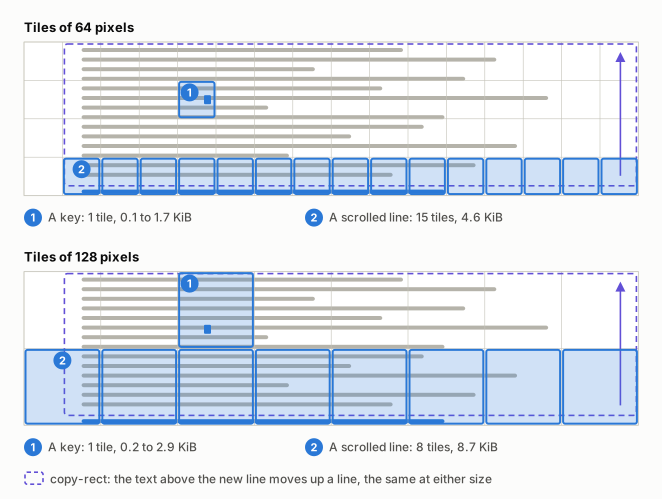
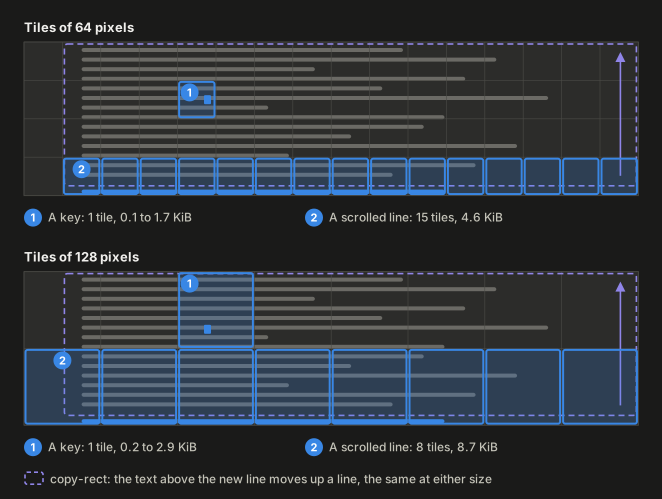
A change sends the tiles it touches whole:
| Change | 64 pixels: tiles · KiB | 128 pixels: tiles · KiB |
|---|---|---|
| A key in the browser's text | 1 · 1.7 | 1 · 2.9, lossy |
| A key in either terminal, or the probe swatch | 1 · 0.1–0.2 | 1 · 0.2–0.3 |
| A scrolled line, after a copy-rect of 13 rows | 15 · 4.6 | 8 · 8.7 |
| The dragged window, one update | 35 · 12.0–12.3 | 12 · 10.5–10.7 |
At 128 pixels, the browser's key tile has 257 colours, so it goes lossy
until refinement. With JPEG from jpegn for the lossy tiles, the key
costs 4.4 KiB at 128 pixels, and the drag 36 KiB at 64 pixels instead
of 23, because JPEG pays its headers for each tile. The drag goes as
tiles, since occamyd detects only vertical scrolls and the window
also moves sideways.
Larger tiles also mix more content, so more of the screen crosses 256 colours and goes lossy: 42 % of the browser page's area at 128 pixels, against 6 % at 64, and 25 % of the drag's, against 18 %. At 128 pixels, text beside a link or a code block would blur until refinement.
Full frames, such as the first that a viewer receives, cost more at 64 pixels, because each tile carries its own palette and starts deflate afresh. The cost is in the exact tiles: the desktop and both terminals have no lossy tile and gain the most at 128, and merging lossy tiles into one image doesn't recover it:
| Scene | 64 pixels: KiB · ms a frame | 128 pixels: KiB · ms a frame | KiB at 64 ÷ KiB at 128 |
|---|---|---|---|
| desktop | 15.1 · 1.4 | 6.9 · 0.6 | 2.2 |
| terminal | 17.4 · 1.5 | 11.6 · 0.7 | 1.5 |
| terminal-aa | 103.2 · 3.9 | 63.2 · 1.6 | 1.6 |
| browser | 140.1 · 6.1 | 93.1 · 8.2 | 1.5 |
| photo | 44.1 · 12.4 | 34.9 · 10.8 | 1.3 |
| drag | 24.5 · 3.7 | 15.9 · 3.2 | 1.5 |
| scroll | 55.4 · 3.6 | 52.2 · 1.9 | 1.06 |
| motion, exact | 388.1 · 8.0 | 343.9 · 4.5 | 1.13 |
Pixels in RGBA order
occamyd keeps every pixel as red, green, blue and alpha, from the
backend to the client, so no step in between reorders one:
- The source. x11vnc sends red, green, blue and a padding byte when a client asks for that order with SetPixelFormat, and the photograph came identically in that order and in x11vnc's own blue-first one. Occamy's VNC backend asks for it and makes the padding opaque alpha, and its RDP backend decodes each bitmap into RGBA.
- The encoders.
image/png,image/jpeg,jpegnand both WebP libraries takeimage.RGBAorimage.NRGBA. With BGRX, every lossy and PNG encode would first swap channels: 3.3 µs a 64-pixel tile and 12.7 µs at 128, about 0.6 ms a frame, 45 % of the 1.4 ms thatpal+flate1takes to encode the whole desktop. - The bytes. Raw pixels deflate the same in either channel order, RGB and BGR within 0.8 % of each other in every class. Dropping the padding byte matters more: four bytes a pixel deflate 1 to 14 % larger at 64 pixels, up to 31 % larger at 128, and up to 2.2 times as slowly above 256 colours, which is why the container stores three. The layouts took turns going first, so that the CPU's cache favoured none.
- The clients. A browser's
ImageDataandcreateImageBitmapare RGBA. Core Graphics draws either order natively, so Occamy for macOS gains nothing from BGRX.
RGBA is also the order of the protocol's raw codec
and of occamyd's framebuffer.
WebP for photographs
A lossy tile goes as WebP from gen2brain/vpx/webp at method 0, or as
JPEG from jpegn. On the tiles of more than 256 colours at 64 pixels,
over all scenes, at the same quality setting: bits a pixel · SSIM ·
encode µs a tile · Go decode µs a tile.
| Codec | q30 | q70 | q90 |
|---|---|---|---|
| jpeg | 1.51 · 0.850 · 42 · 26 | 1.95 · 0.890 · 40 · 28 | 3.03 · 0.934 · 54 · 38 |
| jpegn | 1.58 · 0.850 · 12 · 14 | 2.01 · 0.890 · 12 · 13 | 3.10 · 0.934 · 16 · 19 |
| webp-vpx0 | 0.37 · 0.845 · 66 · 32 | 0.62 · 0.867 · 70 · 35 | 1.91 · 0.959 · 123 · 65 |
| webp-vpx4 | 0.35 · 0.849 · 176 · 30 | 0.59 · 0.872 · 212 · 36 | 1.99 · 0.969 · 355 · 70 |
| webp-dt0 | 0.39 · 0.830 · 143 · 29 | 0.70 · 0.872 · 137 · 33 | 2.06 · 0.964 · 258 · 59 |
At the same setting, WebP scores lower than JPEG at q30 and q70, and higher at q90, so this table compares them at the same SSIM, interpolated between the measured qualities: KiB a frame of each scene's lossy tiles, the quality that reaches that SSIM, and encode ms a frame there.
| Tiles | Codec | SSIM 0.85 | SSIM 0.90 | SSIM 0.95 |
|---|---|---|---|---|
| photo, 64 | jpeg | 149 (q50) · 7.0 | 233 (q84) · 9.2 | not reached |
| photo, 64 | jpegn | 155 (q50) · 2.0 | 239 (q84) · 2.7 | not reached |
| photo, 64 | webp-vpx0 | 52 (q72) · 13.1 | 110 (q83) · 18.2 | 170 (q90) · 22.9 |
| photo, 64 | webp-vpx4 | 47 (q71) · 39.2 | 105 (q82) · 52.6 | 171 (q88) · 65.1 |
| drag, 64 | jpeg | 27 or less (q30) · 1.5 | 30 (q50) · 1.3 | 53 (q90) · 1.9 |
| drag, 64 | jpegn | 29 or less (q30) · 0.4 | 31 (q50) · 0.4 | 54 (q90) · 0.6 |
| drag, 64 | webp-vpx0 | 7 or less (q30) · 2.4 | 13 (q71) · 2.7 | 28 (q86) · 3.9 |
| photo, 128 | jpeg | 66 (q50) · 7.6 | 150 (q84) · 9.6 | not reached |
| photo, 128 | webp-vpx0 | 43 (q72) · 11.5 | 98 (q83) · 16.4 | 157 (q90) · 21.1 |
A full-screen frame is 192 tiles of 64 pixels, or 12 rows of 16, and pays the headers once for each image: KiB · SSIM · encode ms a frame.
| Scene | Unit | jpeg q30 | jpeg q70 | jpegn q70 | webp-vpx0 q30 | webp-vpx0 q70 |
|---|---|---|---|---|---|---|
| motion | 64-pixel tiles | 137 · 0.979 · 7.6 | 149 · 0.992 · 6.1 | 155 · 0.992 · 1.9 | 26 · 0.989 · 11.3 | 33 · 0.991 · 11.0 |
| motion | rows of tiles | 33 · 0.979 · 6.9 | 44 · 0.992 · 7.0 | 44 · 0.992 · 1.5 | 14 · 0.989 · 8.3 | 18 · 0.990 · 8.5 |
| motion | frame | 26 · 0.979 · 7.4 | 38 · 0.992 · 7.6 | 38 · 0.992 · 1.6 | 11 · 0.989 · 8.7 | 15 · 0.990 · 8.6 |
| photo | rows of tiles | 32 · 0.830 · 7.2 | 70 · 0.871 · 7.9 | 71 · 0.871 · 1.8 | 14 · 0.824 · 8.2 | 31 · 0.843 · 9.8 |
| photo | frame | 25 · 0.830 · 7.6 | 64 · 0.871 · 8.5 | 64 · 0.871 · 1.8 | 13 · 0.824 · 8.2 | 30 · 0.843 · 9.8 |
- WebP takes fewer bytes at the same SSIM. JPEG takes 1.9 to 2.9 times WebP's bytes on the photograph's and the drag's 64-pixel tiles, 1.5 times on the photograph's 128-pixel tiles, and 2.8 to 2.9 times on the plasma's rows and frames at 0.989. On the photograph's 64-pixel tiles, JPEG at q70 scores an SSIM of 0.871 in 175 KiB, which WebP reaches at about q78 in about 75 KiB. Whole rows of this grainy photograph narrow the gap: at that SSIM, WebP takes about 62 KiB where JPEG takes 70 (61 and 64 as one image), and at 0.92 about 117 KiB where JPEG takes 175.
- WebP costs more CPU. At the qualities that reach the same SSIM,
vpxat method 0 takes 1.9 to 2.1 timesimage/jpeg's encode time and 6.5 to 7 timesjpegn's: 18 ms of one core for the photograph's full screen at 0.90, or 4 to 5 ms over four cores. The per-tile table's 1.6 to 1.8 times compares the same settings at q30 to q70, where WebP's quality is lower. Method 4 saves another 4 to 20 % for three times the time.deepteams/webpis as small at method 0 and twice as slow, and its method 4 is worse at the same SSIM. jpegnwrites JPEG of the same quality asimage/jpegat the same setting, within 5 % of its bytes (34 more bytes of headers a tile), in a third of the time to encode and half the time to decode.
Lossy tiles while they move
Full-screen motion in the benchmark is a plasma, which has 17 to 256 colours in every tile, so picking codecs by colours alone would send it exactly. Lossy, by class, at 64 pixels: bits a pixel · SSIM.
| Tiles | pal+flate1 | webp-vpx0 q30 | webp-vpx0 q70 | jpegn q70 |
|---|---|---|---|---|
| motion, 17–256 colours | 4.04 · 1 | 0.27 · 0.989 | 0.35 · 0.991 | 1.62 · 0.992 |
| browser, 17–256 colours | 2.03 · 1 | 1.26 · 0.985 | 1.61 · 0.994 | 2.83 · 0.972 |
| terminal-aa, 17–256 colours | 2.16 · 1 | 1.25 · 0.984 | 1.61 · 0.993 | 2.84 · 0.948 |
| scroll, 2 colours | 0.60 · 1 | 2.76 · 0.992 | 3.32 · 0.997 | 5.17 · 0.976 |
| terminal, 2 colours | 0.23 · 1 | 1.98 · 0.994 | 2.31 · 0.997 | 4.02 · 0.973 |
On the plasma, lossy output is a fifteenth of the size of exact output. On antialiased text it's a fifth to two fifths smaller, at a visible loss, and on two-colour text it takes 5 to 10 times the bytes of exact output, so a tile of 17 to 256 colours goes lossy only while it moves.
The cheapest full-screen motion measured is WebP at quality 30: 11 KiB
a frame as one image and 14 KiB as rows of tiles, at an SSIM of 0.989,
where JPEG from jpegn takes 32 and 38 KiB at the same SSIM.
Benchmarks gives what
Occamy sends of the motion and the photograph against Guacamole.
How it was measured
The recorded frames
The measurement uses 13 frames of the bench desktop at 1024 × 768,
recorded over VNC by make corpus and described in
bench/testdata/corpus. They
take 2.5 MiB, and each scene is real content or a scene of the
benchmark:
| Scene | Frames | What it shows |
|---|---|---|
| desktop | 1 | The idle desktop: a gradient wallpaper |
| terminal | 1 | xterm with its bitmap font |
| terminal-aa | 1 | xterm with an antialiased font |
| browser | 1 | A documentation page in dillo |
| photo | 1 | The benchmark's photograph |
| drag | 3 | Consecutive updates of the benchmark's dragged window |
| scroll | 3 | Consecutive updates of the benchmark's scrolling text |
| motion | 2 | Consecutive updates of the benchmark's full-screen plasma |
The tile classes
The measurement splits each frame into tiles of 64 and 128 pixels with
occamyd's framebuffer, and sorts the tiles by their colours as
occamyd does, in finer classes. At 64 pixels:
| Scene | Frames | 1 colour | 2 | 3–16 | 17–256 | over 256 |
|---|---|---|---|---|---|---|
| desktop | 1 | 0 | 0 | 192 | 0 | 0 |
| terminal | 1 | 32 | 43 | 117 | 0 | 0 |
| terminal-aa | 1 | 27 | 0 | 76 | 89 | 0 |
| browser | 1 | 8 | 1 | 50 | 121 | 12 |
| photo | 1 | 0 | 0 | 0 | 0 | 192 |
| drag | 3 | 0 | 0 | 471 | 0 | 105 |
| scroll | 3 | 0 | 540 | 36 | 0 | 0 |
| motion | 2 | 0 | 0 | 0 | 384 | 0 |
The wallpaper's gradient changes every few rows, so its tiles have 3 to
16 colours. Antialiased text has 17 to 256, as does every tile of the
plasma, which draws from a palette of 256 colours. Counting a tile's
colours stops at 257 and takes 6 to 14 µs a 64-pixel tile, 1.2 to
2.7 ms a frame, which the tables report apart and leave out of the
encode times of pal+* and png*.
The run
bench/codecs encodes and decodes every tile with every candidate,
five times. A tile's time is the median of its five, and a table sums
those medians. No exact result differed from the original pixels. SSIM
is luma SSIM, with BT.601 weights, 8 × 8 windows and the usual
constants, averaged over tiles.
It ran on 2026-10-30 from 19:31 to 19:35 UTC on the Apple M5 Pro (18
cores) of the benchmarks, with Go 1.27.1 on arm64
and GOMAXPROCS=1, so every time is one core's, even a library's that
would otherwise spread one image over several cores.
The host's one-minute load average, which
codecs-load.log logs every 30 seconds, stayed
between 4.7 and 8.8, with other work on it. An earlier run at 11:50
gave the same bytes and SSIM for every tile, and times within 5 % of
this run's for 95 % of the sums of each codec and class, and within
10 % for 98 %; the rest were tiles of one colour, which take less than
a microsecond.
codecs-tables.md has every table the measurement wrote, and codecs.json every result.
The candidates
| Name | What it is |
|---|---|
pal+flate1, pal+flate6 |
The palette container, with compress/flate at levels 1 and 6 |
pal+kflate1 |
The same, with klauspost/compress/flate at level 1 |
pal+zstd1, pal+zstd3 |
The same, with klauspost/compress/zstd at its fastest and its default level; no browser decodes zstd natively |
png1, png6 |
image/png at best speed and at its default, with a palette for up to 256 colours, which decoding expands through a table |
qoi |
QOI, written for the measurement |
webpll-dt0, webpll-dt4 |
Lossless WebP from deepteams/webp v1.2.8: method 0 at effort 0, and method 4 at effort 75 |
webpll-vpx0, webpll-vpx4 |
Lossless WebP from gen2brain/vpx/webp v0.2.1, methods 0 and 4 |
jpeg qN |
image/jpeg with 4:2:0 chroma subsampling, at qualities 30 to 90 |
jpegn qN |
gen2brain/jpegn v0.6.2: baseline, 4:2:0, with the standard tables |
webp-dtM qN |
Lossy WebP from deepteams/webp, methods 0 and 4 |
webp-vpxM qN |
Lossy WebP from gen2brain/vpx/webp, methods 0 and 4, on one goroutine |
All are pure Go, and the WebP and JPEG libraries use assembly on arm64.
The palette container (bench/codecs/palette.go) is the protocol's
deflate container in its opaque
forms, 0 for a palette and 1 for three bytes a pixel.
Measure again
make corpus   # records the frames in bench/testdata/corpus again
make codecs   # measures, and writes codecs.json, codecs-tables.md and codecs-load.log here
make codecs runs
go test -tags measure -run TestMeasure -timeout 2h . -args -out ../../docs/benchmarks
in bench/codecs. That directory is a Go module of its own, so that
occamyd's module requires only the codecs it uses, vpx and jpegn,
and none of the other candidates.
What the measurement doesn't cover
- SSIM is on luma, so it doesn't see chroma subsampling. Text in colour, such as a link, loses more under 4:2:0 than the scores show. Scoring chroma as well, as a review of this measurement did, doesn't favour WebP.
- Decode times are Go's, as Occamy for macOS decodes. The browser's
native decoders and
DecompressionStream, and the web client's palette expansion in JavaScript, aren't measured. - The scenes are the bench desktop's. The two terminals and the page are real applications, while the photograph, the plasma and the scrolled text are generated. A real video or photograph has more detail than the plasma and less grain than the photograph.